
Landing Page Design Best Practices for Lead Generation
Driving traffic to your website is only half the battle. The real challenge is converting visitors into leads.
This is where landing pages play a critical role.
A landing page is designed with one specific goal: turning visitors into potential customers. Unlike a traditional website page that contains multiple navigation options and distractions, a landing page focuses attention on a single offer and encourages users to take action.
Whether you’re running Google Ads, Facebook campaigns, email marketing, or SEO campaigns, your landing page can significantly impact your conversion rates and marketing ROI.
Even small improvements in landing page design can dramatically increase leads without increasing advertising spend.
This guide explains the best landing page design practices for lead generation, common mistakes to avoid, and proven strategies businesses can use to improve conversions in 2026.
What Is a Landing Page?
A landing page is a standalone web page specifically designed to encourage visitors to complete a desired action.
Common goals include:
- Filling out a contact form
- Scheduling a consultation
- Downloading an ebook
- Requesting a quote
- Registering for an event
- Starting a free trial
Unlike a homepage, a landing page focuses on one objective and removes unnecessary distractions.
Why Landing Pages Matter for Lead Generation
Businesses often spend thousands of dollars driving traffic but lose potential customers because their landing pages are poorly designed.
A high-converting landing page can:
- Increase leads
- Lower customer acquisition costs
- Improve advertising ROI
- Generate more qualified prospects
- Increase sales opportunities
Related Reading:
Internal Link: Website Development for Lead Generation: Best Practices
Benefits of High-Converting Landing Pages
Better Conversion Rates
Landing pages typically convert better than standard website pages because they focus on one action.
Improved User Experience
Visitors quickly understand:
- What you offer
- Why it matters
- What they should do next
Better Campaign Tracking
Landing pages make it easier to measure marketing performance.
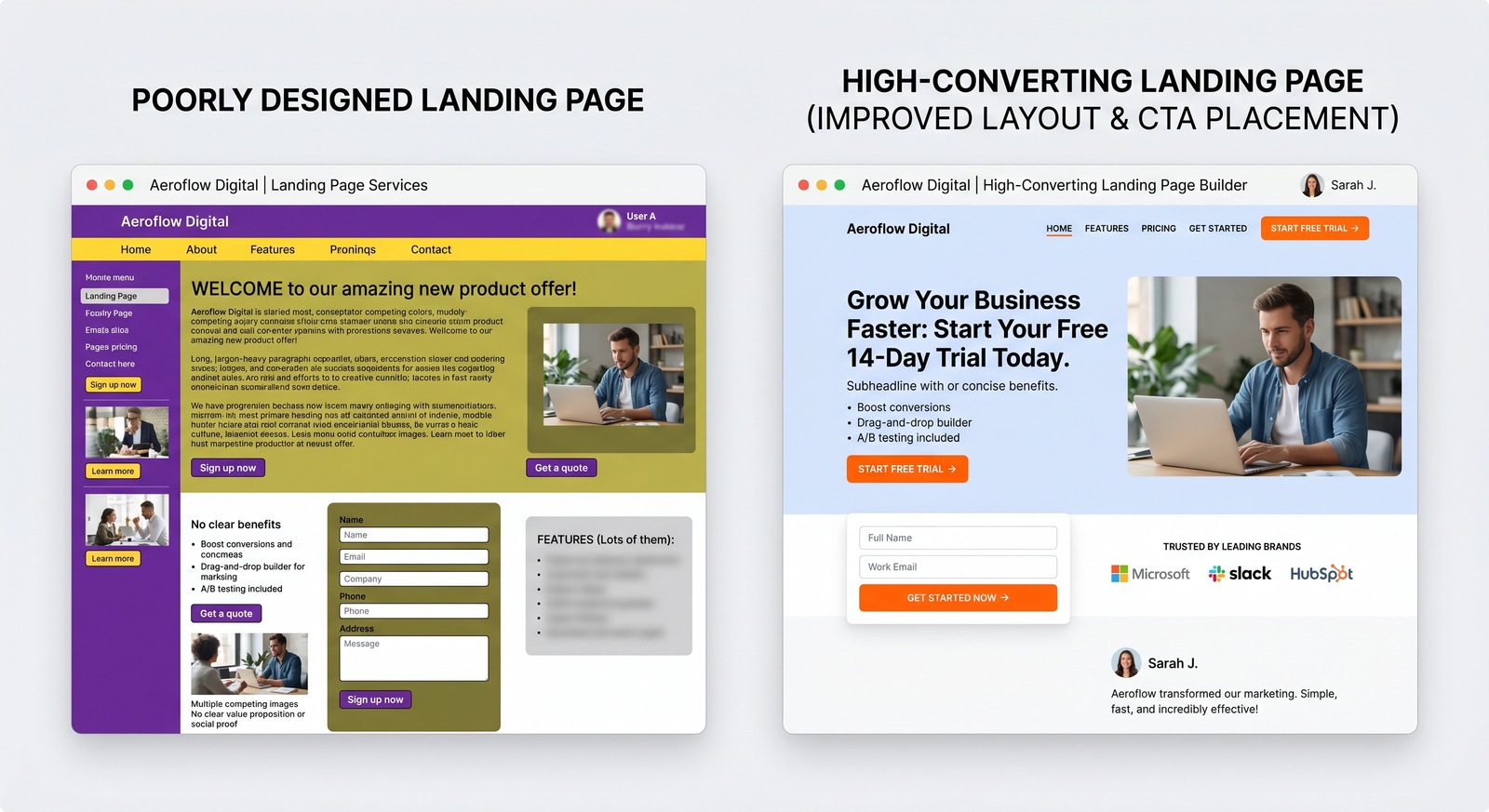
Higher Marketing ROI
Small conversion improvements can significantly reduce acquisition costs.
Related Reading:
Internal Link: Website Conversion Rate Optimization (CRO): How to Turn Visitors into Customers (2026)
The Anatomy of a High-Converting Landing Page
A successful landing page contains several essential components.
1. Compelling Headline
The headline is the first thing visitors notice.
It should clearly communicate:
- What you offer
- Who it’s for
- The primary benefit
Good Example:
“Get a Free Website Audit and Discover Why Your Business Isn’t Generating Leads”
Weak Example:
“Welcome to Our Website”
2. Strong Subheadline
The subheadline provides additional context and reinforces the offer.
Example:
“Receive a personalized report highlighting SEO issues, speed problems, and conversion opportunities.”
3. Clear Value Proposition
Answer three questions immediately:
- What do you offer?
- Why should people care?
- Why choose your business?
4. Professional Hero Image
Images can significantly influence conversions.
Examples:
- Product screenshots
- Team photos
- Service demonstrations
- Before-and-after comparisons
Avoid generic stock photography whenever possible.
5. Lead Capture Form
The form is the conversion point.
Ask only for necessary information.
Short Form Example:
- Name
- Phone Number
Long Form Example:
- Company Name
- Budget
- Project Requirements
- Industry
Shorter forms usually convert better.
Landing Page Design Best Practices
Keep the Design Simple
Clutter reduces conversions.
Focus on:
- White space
- Clear hierarchy
- Minimal distractions
Remove Navigation Menus
Most landing pages perform better without traditional website navigation.
The goal is to keep visitors focused on one action.
Use One Primary Call-To-Action
Multiple CTAs often confuse users.
Examples:
- Get a Free Quote
- Book a Consultation
- Download the Guide
Stick with one primary action.
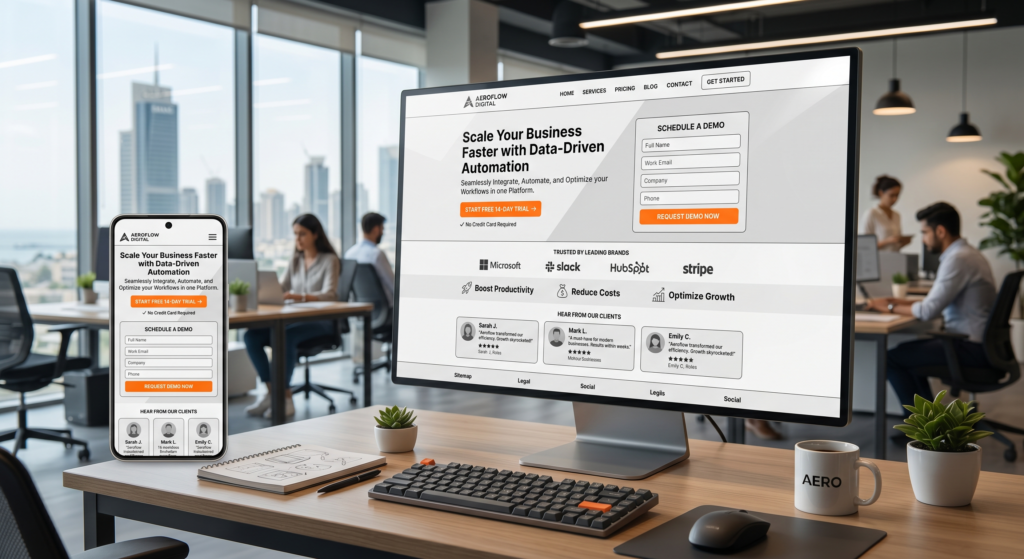
Make the CTA Stand Out
Your call-to-action button should:
- Be highly visible
- Use action-oriented text
- Appear multiple times on the page
Examples:
- Get My Free Audit
- Schedule My Consultation
- Start My Free Trial
Use Benefit-Focused Copy
Don’t simply list features.
Explain outcomes.
Instead of:
“24/7 Customer Support”
Try:
“Get Expert Support Whenever You Need Help.”
Build Trust with Social Proof
Trust signals increase conversions.
Include:
- Testimonials
- Reviews
- Client logos
- Certifications
- Case studies
Related Reading:
Internal Link: How Professional Website Development Helps Your Business Grow
Use Urgency and Scarcity Carefully
Examples:
- Limited spots available
- Offer expires Friday
- Free consultation for the first 20 businesses
Avoid fake urgency, as it damages credibility.
Mobile-First Landing Page Design
More than half of website traffic now comes from mobile devices.
A landing page that performs well on desktop but poorly on mobile will lose valuable leads.
Best practices include:
- Fast loading speed
- Responsive design
- Easy-to-tap buttons
- Readable text
- Simplified forms
Related Reading:
Internal Link: Mobile-First Website Design: Why It’s Critical in 2026

Page Speed Matters
Every second of delay can reduce conversions.
Improve speed by:
- Compressing images
- Using quality hosting
- Minimizing scripts
- Implementing caching
Related Reading:
Internal Link: How Website Speed Impacts SEO & Conversions
SEO Considerations for Landing Pages
Many businesses ignore SEO when building landing pages.
Important considerations include:
Keyword Optimization
Include:
- Title tag
- Meta description
- Headings
- Content naturally
Internal Linking
Link to relevant pages when appropriate.
Mobile Optimization
Google prioritizes mobile usability.
Fast Performance
Page speed affects rankings and conversions.
Landing Page Structure Example
Hero Section
Headline, CTA, and value proposition.
Problem Section
Explain customer pain points.
Solution Section
Present your offer.
Benefits Section
Highlight outcomes.
Social Proof
Testimonials and case studies.
Final CTA
Encourage action.
Landing Page vs Homepage
| Feature | Landing Page | Homepage |
|---|---|---|
| Goal | One conversion action | Multiple goals |
| Navigation | Minimal | Extensive |
| Content | Focused | Broad |
| Conversion Rate | Higher | Lower |
| Traffic Source | Campaign-specific | General traffic |
Related Reading:
Internal Link: How to Create a High-Converting Business Homepage (2026 Guide)
Common Landing Page Mistakes
Too Many CTAs
Confuses visitors.
Weak Headlines
Visitors leave without understanding the offer.
Long Forms
Reduce conversions.
Poor Mobile Experience
Loses mobile traffic.
Slow Page Speed
Increases bounce rates.
No Social Proof
Makes offers less trustworthy.
Related Reading:
Internal Link: Why Most Business Websites Don’t Convert (And How to Fix It)

Landing Page Examples by Industry
Digital Agencies
Offer:
Free website audits.
Real Estate
Offer:
Property consultation.
Healthcare
Offer:
Appointment booking.
SaaS Companies
Offer:
Free trial.
Ecommerce
Offer:
Discount coupons.
How A/B Testing Improves Landing Page Performance
Test:
- Headlines
- CTA buttons
- Images
- Form lengths
- Page layouts
Small changes often produce significant improvements.
Related Reading:
Internal Link: How Website Analytics Can Improve Your Business ROI
Landing Page Metrics to Track
| Metric | Why It Matters |
|---|---|
| Conversion Rate | Measures performance |
| Bounce Rate | Indicates engagement |
| Time on Page | Measures interest |
| Cost Per Lead | Determines profitability |
| Form Completion Rate | Measures usability |
Conclusion
Landing pages are among the most powerful lead generation tools available to businesses. A well-designed landing page can significantly increase conversions, reduce acquisition costs, and improve overall marketing performance.
The most effective landing pages focus on one goal, eliminate distractions, communicate value clearly, and guide visitors toward taking action.
Businesses that continuously test and optimize their landing pages often achieve dramatically better results without increasing advertising budgets.
Call-To-Action
Need a high-converting landing page that generates more leads and sales?
Omocracy designs conversion-focused landing pages optimized for SEO, speed, user experience, and lead generation.
Contact Omocracy today and start turning your website visitors into paying customers.
External Resources
- Google Search Central – Landing Page SEO Best Practices
- HubSpot – Landing Page Conversion Optimization Guide
- Semrush – Conversion Rate Optimization Resources
- WordPress – Landing Page Building Resources
Frequently Asked Questions (FAQ)
What is a landing page?
A standalone page designed to encourage a specific action.
Why are landing pages important?
They improve conversions and lead generation.
What makes a good landing page?
Clear messaging, strong CTAs, and excellent user experience.
Should landing pages have navigation?
Usually no, to minimize distractions.
How long should a landing page be?
As long as necessary to convince visitors.
What is a good landing page conversion rate?
Many industries aim for 5% to 10% or higher.
Why does mobile optimization matter?
Most website traffic now comes from mobile devices.
How many form fields should I use?
Only ask for essential information.
Should landing pages be SEO optimized?
Yes, especially for organic traffic campaigns.
Why should businesses A/B test landing pages?
Testing helps identify what improves conversions.