
Create a High-Converting Business Homepage
Your homepage is often the first impression customers have of your business. Within seconds, visitors decide whether to stay or leave which means your homepage must be designed to capture attention, build trust, and drive action.
A high-converting homepage doesn’t just look good, it is strategically designed to guide visitors toward becoming customers.
In this guide, we’ll break down how to create a homepage that converts in 2026 using proven design, UX, and CRO strategies.
Why Your Homepage Matters
Your homepage acts as the central hub of your website. It should clearly communicate:
- What your business does
- Who it’s for
- Why customers should choose you
A poorly designed homepage can drive visitors away, even if your product or service is excellent.
Related:
First Impression Matters: Website Design for Businesses (2026)
Start with a Clear Value Proposition
Your value proposition should immediately tell visitors:
- What you offer
- How it benefits them
- Why you’re different
Place this in a strong headline above the fold (visible without scrolling).
Example:
“Professional Website Development That Generates Leads & Sales”
Clarity is more important than creativity here.
Use a Strong Call-to-Action (CTA)
Every homepage must guide users toward action.
Effective CTAs:
- “Get a Free Quote”
- “Start Your Project”
- “Contact Us Today”
Your CTA should be:
- Visible immediately
- Repeated throughout the page
- Designed with contrasting colors
Improve conversions here:
Website Conversion Rate Optimization (CRO): How to Turn Visitors into Customers (2026)

Design for Simplicity and Clarity
Cluttered homepages confuse visitors and reduce conversions.
Best practices:
- Use clean layouts
- Limit text
- Highlight key information
- Use whitespace effectively
Simple designs perform better because they reduce cognitive overload.
Avoid mistakes:
Common Website Design Mistakes That Hurt SEO in 2026
Optimize for Mobile Users
Most users visit websites via mobile devices, so your homepage must be mobile-friendly.
Key elements:
- Responsive design
- Fast loading speed
- Easy navigation
- Clickable buttons
Learn more:
Mobile-First Website Design: Why It’s Critical in 2026
Build Trust Instantly
Trust is critical for conversions.
Add elements such as:
- Customer testimonials
- Client logos
- Reviews and ratings
- Certifications
- Clear contact information
Global brands like Amazon and Airbnb use trust signals effectively to increase conversions.
Use High-Quality Visuals
Visual content helps communicate your brand quickly.
Use:
- Professional images
- Product visuals
- Service illustrations
- Short videos
Avoid low-quality or generic visuals, as they reduce credibility.
Highlight Your Key Services
Your homepage should clearly showcase your core services.
For example:
- Website Development
- Branding
- Social Media Marketing
Each section should include:
- Brief description
- Benefits
- Link to detailed service page
Explore:
Website Development Services for Businesses: Complete Guide
Improve Navigation for Better UX
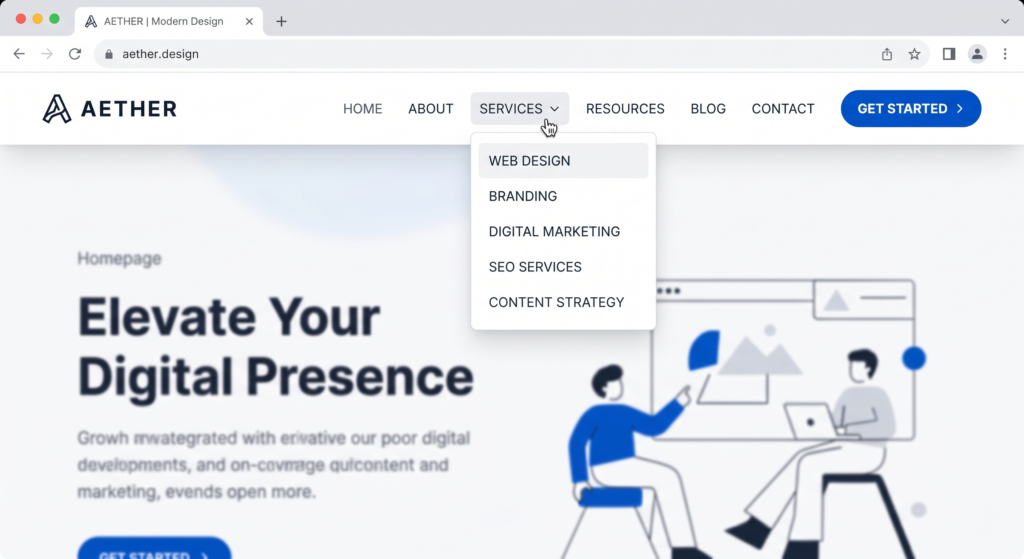
Navigation should help users find information quickly.
Best practices:
- Simple menu structure
- Clear categories
- Visible contact options
Learn more:
How to Optimize Website Navigation for Better User Experience
Focus on Page Speed
Speed directly impacts conversions.
A slow homepage leads to:
- High bounce rates
- Lower engagement
- Lost sales
Optimize speed:
How Website Speed Impacts SEO & Conversions
Test performance here:
https://pagespeed.web.dev/
Use Conversion-Focused Sections
High-converting homepages often include:
- Hero section (headline + CTA)
- About section (build trust)
- Services overview
- Testimonials
- Call-to-action section
- Contact form
Each section should guide users closer to conversion.
Add Internal Links to Key Pages
Your homepage should link to important pages such as:
- Services
- Blog posts
- Contact page
Examples:
- Website Development for Lead Generation: Best Practices
- Why Most Business Websites Don’t Convert (And How to Fix It)
- Landing Page Design Tips That Increase Leads
This improves both SEO and user navigation.
Use Analytics to Improve Performance
Track homepage performance using tools like Google Analytics.
Measure:
- Bounce rate
- Conversion rate
- User behavior
Learn more:
How Website Analytics Can Improve Your Business ROI
You can also explore insights here:
https://www.nngroup.com/articles/homepage-design/
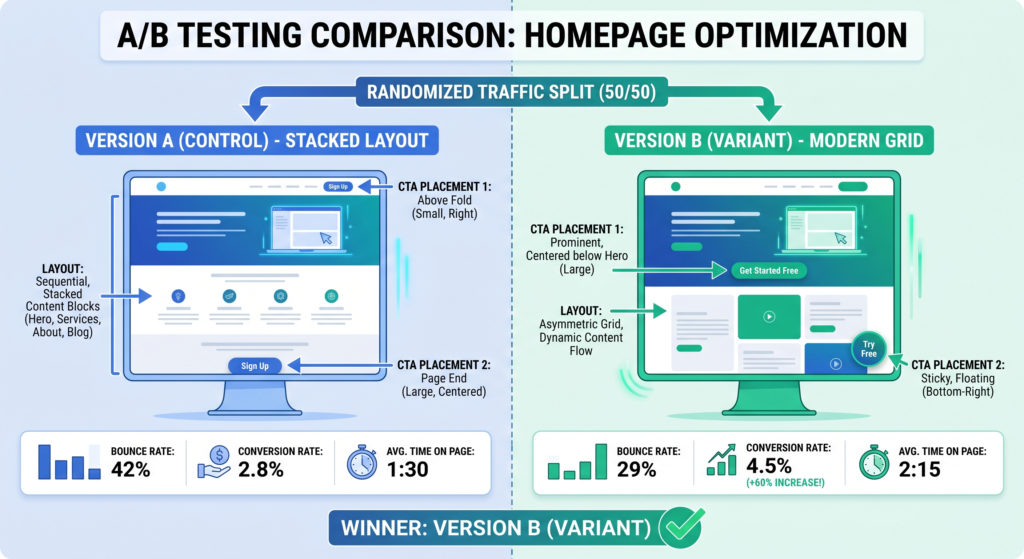
Keep Testing and Improving
A high-converting homepage is never “finished.”
Use A/B testing to improve:
- Headlines
- CTAs
- Layouts
- Visuals
Continuous improvement leads to better results over time.
Conclusion
A high-converting homepage combines clear messaging, strong design, trust elements, and strategic optimization. It should guide visitors seamlessly from interest to action.
By focusing on user experience, speed, mobile optimization, and conversion strategies, businesses can turn their homepage into a powerful sales tool.
In 2026, successful businesses are not those who guess they are those who track, analyze, and optimize continuously. Businesses that invest in professional Website Development Services can create websites that are accessible, SEO-friendly, and conversion-focused.
FAQs
What makes a homepage high-converting?
A high-converting homepage includes a clear value proposition, strong CTA, fast loading speed, and trust elements.
How important is homepage design for business?
Homepage design is critical because it creates the first impression and influences whether visitors stay or leave.
What should be included on a homepage?
Key elements include headline, services, CTA, testimonials, visuals, and contact information.
How can I improve my homepage conversion rate?
You can improve conversions by optimizing design, improving speed, using strong CTAs, and analyzing user behavior.